What is Sowa Rigpa?
Traditional Tibetan Medicine

Traditional Tibetan Medicine
Sowa Rigpa


The term Sowa Rigpa has two meanings:

  • The first is “science of healing,” since Sowa means “healing” and Rigpa “knowledge.” It can therefore be translated as “science of healing” or “knowledge of health .” It refers to a system of natural healing, whose aim is to prevent and cure disease.

Tibetan Medicine works fundamentally through diet, lifestyle, the use of herbs and treatments such as massage, stone therapy, Yukcho stick therapy, balneotherapy, etc. These methods are set out in SOWA RIGPA's fundamental work, "The Four Tantras of Medicine".

Today, traditional Tibetan medicine is well-known and constitutes one of the three
fundamental systems of Eastern medicine, along with Ayurvedic medicine and Traditional Chinese medicine.
Tibetan medicine, or Sowa Rigpa, follows a specific system of teachings originating from the Himalayan region, namely from countries such as Tibet, India, Bhutan, and Nepal, where this science has been practiced for a long time. Historically, Sowa Rigpa was used in Mongolia and Russia, and only in the last twenty to thirty years has it begun to develop in Western countries as well. Recently, Sowa Rigpa was officially incorporated into the Indian Ministry of Health and is therefore part of the Indian Medical System known as AYUSH (an acronym that encompasses the various ancient and complementary medical systems: AYURVEDA, YOGA, UNANI, SIDDHA, SOWARIGPA, and HOMEOPATHY).

The second meaning of Sowa Rigpa is more closely related to the spiritual aspect. Sowa Rigpa can be translated as "nourishment of awareness." Sowa means "NURSING" or "SUCKLING" (in the sense of growth), and Rigpa is the primordial state of our mind. In this sense, we work to understand our true nature. To do this, we must follow a spiritual tradition, which can be combined with our medical knowledge. For this, we must clearly understand the differences and similarities between the "purely medical" approach and that of spiritual practice.
Further information

Health from the perspective of Traditional Tibetan Medicine

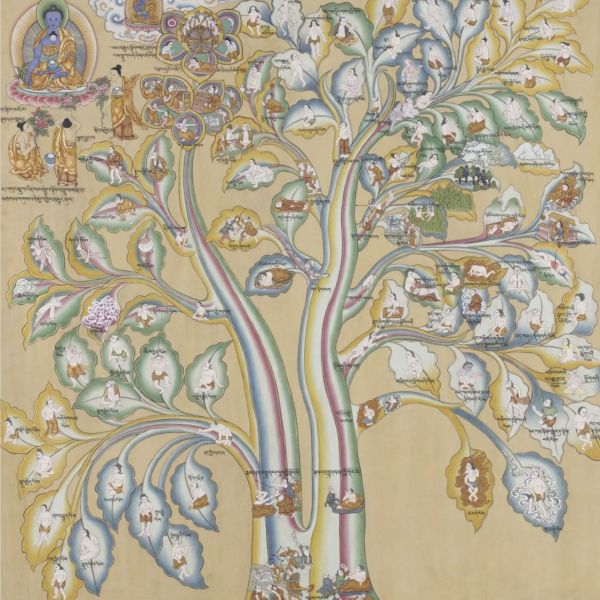
Tibetan medicine offers the image of a circuit that goes from a state of health to disease and, through the healing process, from disease to an initial state of health.

Health is a state of balance between the elements and humors, while disease arises as a result of their imbalance. Consequently, healing is the process of rebalancing the elements and the three humors. For this reason, Tibetan medicine places great importance on understanding the causes of imbalance that lead to disease. The primary cause is related to awareness, while the secondary cause is linked to diet, lifestyle, and other factors.


The main text of Traditional Tibetan Medicine is, in fact, a tantric teaching.

The word Tantra means "unbroken lineage," meaning the teaching passed down uninterruptedly from a fully realized enlightened being to the present day. This means that the teaching actually comes directly from the enlightened knowledge of a supreme being. The study and practice of a tantric teaching therefore allows one to achieve this state. The study of medicine, based on compassion and the intention to help others, allows one to achieve a state of health and balance in the three aspects of a person:  body, energy, and mind.

(Sowa Rigpa) is one of the three major Eastern medical traditions,


Traditional Indian Medicine (Ayurveda) and Traditional Chinese Medicine are two distinct branches of medicine. There are also other minor traditional medicines, but these three are considered the  fundamental ones,  each with its own history and characteristics. There are some similarities between them, but also important differences. To avoid confusion, it is best to study these traditions separately. In the West,  "Oriental medicine" is often referred to  generically, as if it  were a single monolith , overlapping concepts and methods inherent in different traditions.  Naturally, this approach is problematic and creates confusion.