Based on recent research on Tibetan history and culture, it is believed that the oral tradition dates back over 8,000 years, unlike the last century when Sowa Rigpa was believed to have a 4,000-year history. Therefore, based on the sources on which this research is based, it can be said that Tibetan medicine has its roots in the Stone Age. It must be remembered that, contrary to what some scholars claim, Tibetan medicine developed entirely independently in Tibet. Therefore, all knowledge of Tibetan medicine is the fruit of the research, experience, and intuition of Tibetan doctors.
One of the foundational methods of Tibetan medicine is observing the nature and habits of animals. The ancients likely possessed a special intuition that allowed them to understand the properties of plants and use them to restore balance to the body's functions. Observing animal behavior was certainly a source of learning. Indeed, some injured animals search for certain herbs and, when they find them, either alone or with the help of other animals, place them on the painful area.
Tibetan medicine includes approximately 25 medicinal plants whose therapeutic properties were discovered through animal observation. There are likely even more, but for 25 of these, there is evidence that their healing properties were discovered through observation of animals that used them for ailments, wounds, and fractures.
Naturally, Tibetan medical knowledge is based not only on observation of the animal world, but also on the study of nature and its elements. For example, the ancient Tibetans noted therapeutic properties of hot mineral waters and began to study them. They discovered that each spring has specific properties that help treat certain ailments. They noticed that wherever there was a hot spring, different minerals were deposited, and they began to study the healing properties of stones and minerals depending on the source. There were cases where the specific properties of a plant, mineral, or other substance were discovered through a special insight or during meditation.
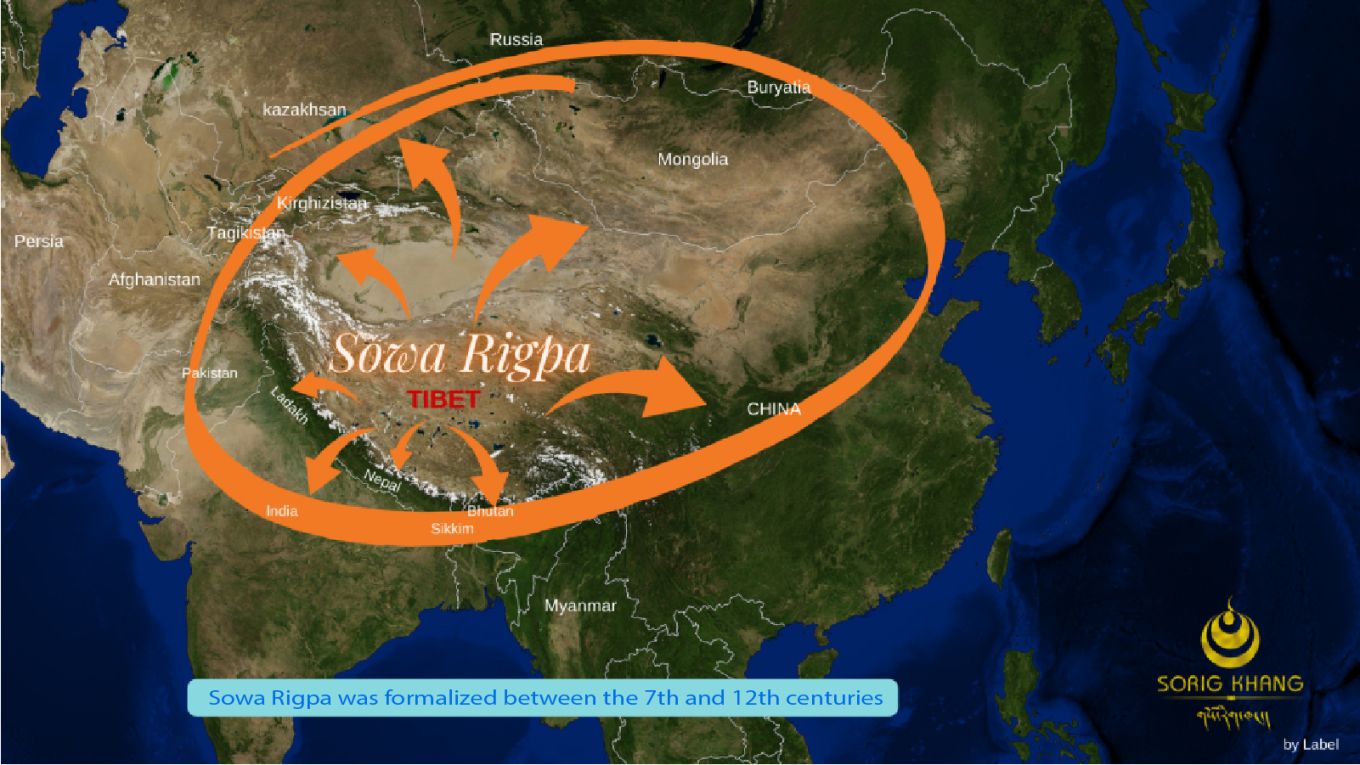
Around three thousand years ago, Tibetan folk wisdom began to influence the medical science and culture of China and India. Research is currently underway to determine whether Chinese medicine has influenced Tibetan medicine, or vice versa.
Those studying the issue, especially historians, until recently believed that Tibetan medicine had been strongly influenced by Chinese medicine. However, recently this view has gradually been reversed, and many have come to the conclusion that Tibetan medicine was, if not the source of Chinese medicine, certainly a major inspiration. This conclusion has been reached not only by Tibetan but also by Chinese researchers.
The first famous Tibetan physician, Dr. Chebu Trishe, wrote the Bum Shi, the oldest extant treatise on Tibetan medicine, in the 20th century BC. The text expounds a comprehensive and precise medical system, both in theory and practice. It comprises three main sections, which deal respectively with diseases, diagnostic methods, and treatments.
During the reign of Lha Thothori Nyentsen (4th century BC) two physicians from India, Vijay Gaje and Bila Gaje, allowed the deepening of medical knowledge by spreading the principles set forth in Ayurvedic medicine.
Thanks to intense trade and cultural exchanges during the reign of Songtsen Gampo (617-698 AD), further new medical knowledge enriched and influenced Tibetan medical science. During this period, the Indian physicians Bharadwaja, Hanwan Hang of China, and Galen of Greece were invited to Tibet to disseminate their healing knowledge.
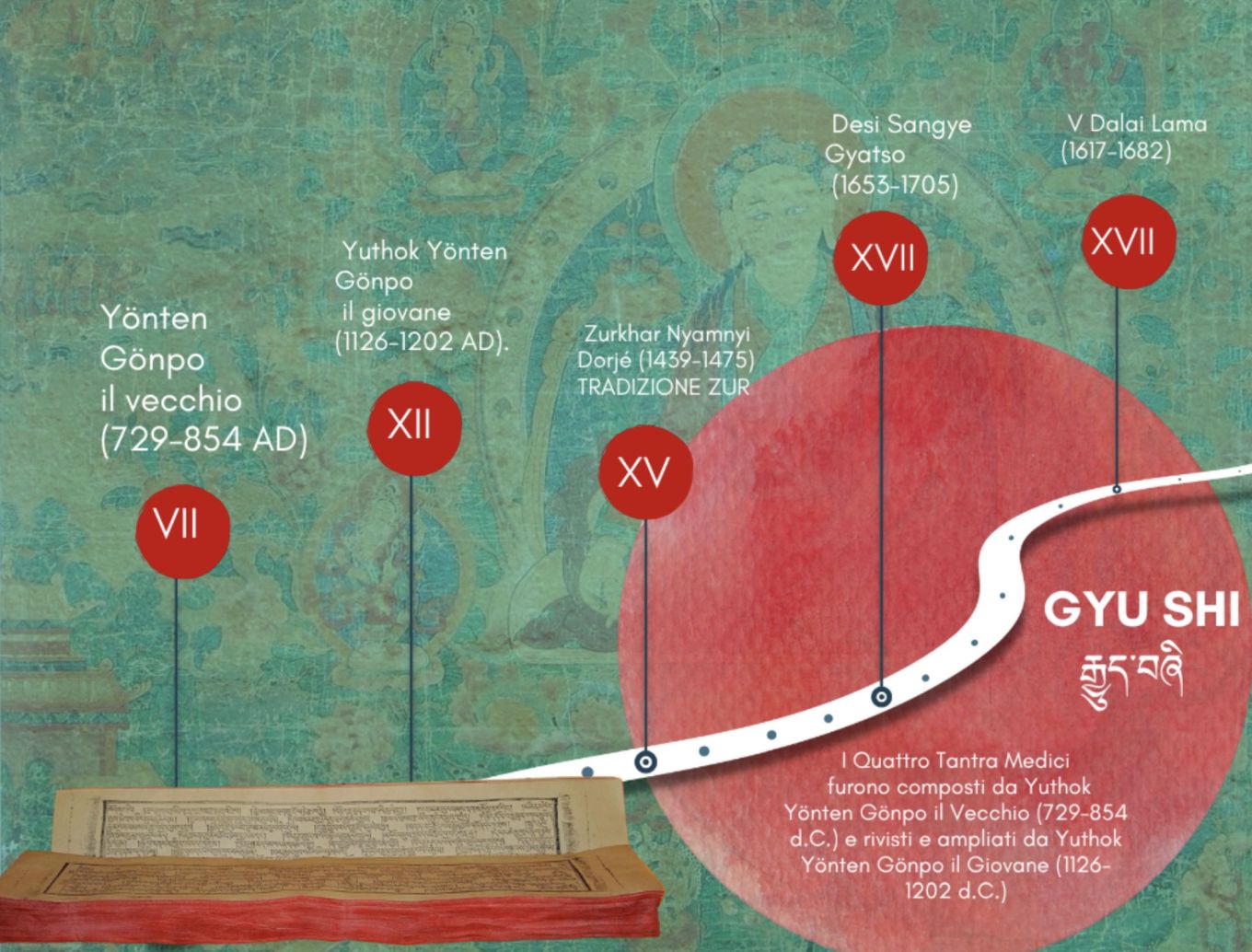
In the 7th century the famous and brilliant physician Yuthok Yonten Gonpo (708-833 AD), called “the Old Man” and considered one of the best physicians ever
lived in Tibet, combined medical systems from India, Persia, and China with those of Western Tibet. Yuthok the Elder
He deepened and revised, enriching the ancient Bum Shi, adding new explanations and changing its name to Gyu Shi, “The Four Glorious Tantras of Tibetan Medicine”.
Yuthok Yonten Gonpo lived a very unusual life. He married at 80, had three children, and died at 125. East of Lhasa, he founded the first Tibetan medical college and hospital, “Kong po sman Lung,” where he personally trained over a thousand doctors and mentored another three hundred highly qualified practitioners who later practiced medicine throughout Tibet.
In the 9th century AD, Terton Dorbum Chodrag composed "The Great Vase of Nectar" and "The Small Vase of Nectar" of Traditional Tibetan Medicine, two of the most famous manuals on the treatment of infectious and contagious diseases. Dr. Dorbum was recognized as the first specialist in the treatment of these diseases.