Looking at Buddhist monasteries, monks, culture, you can notice many symbols and objects that may seem only as ornamental. However, if you look closely you will find that every little thing in Tibetan Buddhism and its practices has a deep meaning. You can find out more about them here.
Eight lucky symbols
These are the most common and popular group of symbols in Tibetan culture. They express different aspects of the "great happiness" or well-being that the Buddha Dharma brings to people's lives - and through human life to the destiny of other sentient beings. The symbols appear together, individually and in linked and organically arranged patterns, on architecture, in the decoration of spaces and objects. They are perceived as evocations, blessings, wishes or protection.
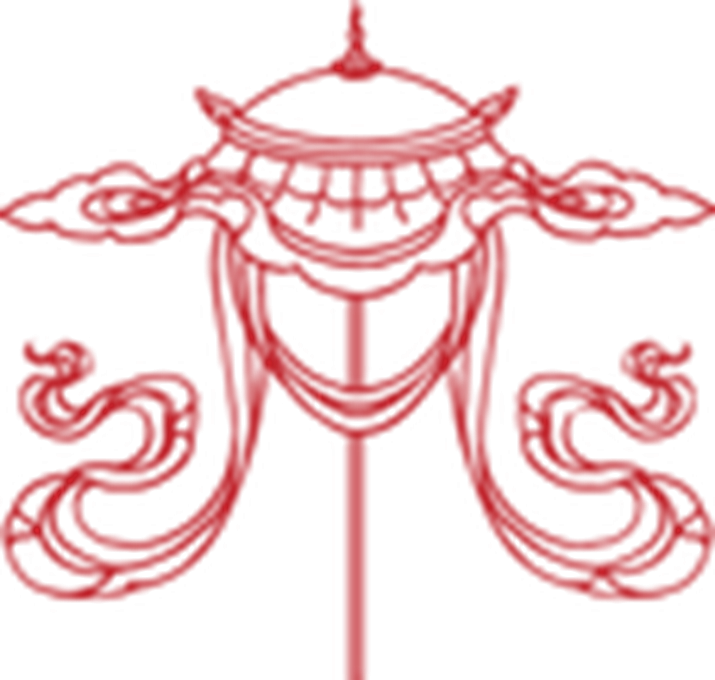
Precious parasol, Tib. rinchen dug
Paraple is an ancient symbol of royal majesty. Like the canopy or "heaven" it expresses grandeur, dignity and also provides protection. It is the shelter of the Buddha under whose protection all beings can take refuge.

Two goldfish, Tib. ser na
They evoke liveliness, the nimble mobility that comes from the freshness of healthy life forces. The life forces, sustained and refreshed by dharma, allow freedom of movement in the flow of a suffering-ridden, conditioned world. It means the ability to skillfully navigate even the waves of the ocean of samsara.

Vase of the Great Treasure, Tib. ter chhenpö bumpa
A vessel carrying a hidden treasure, which it protects within itself, but also passes on in due time. It shows how the resources of life should be preserved, drawn upon and passed on: spiritual wealth, initiation and the medicine and nourishment necessary for life.
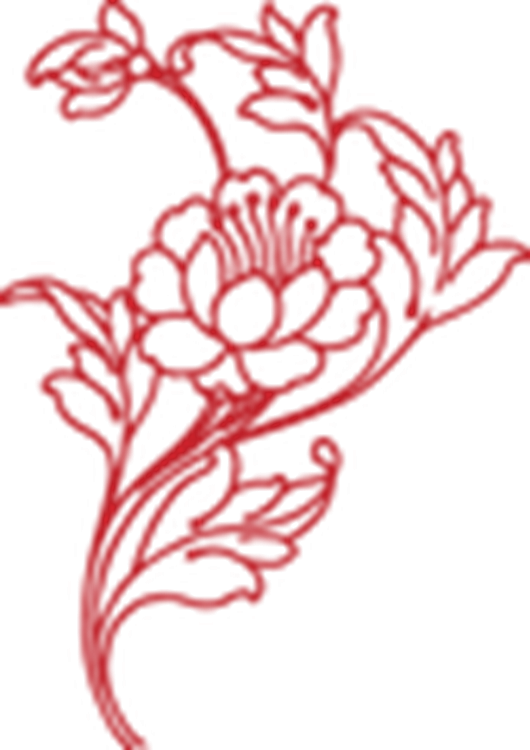
The lotus, (in this case the Tibetan takes the Sanskrit word) padma
Probably the most well-known and universal Buddhist symbol, here too it contributes its original and most special meaning: it represents purification, inner purity developed from within and opening to the light after overcoming the outer impurity - the conditions and sludge of confusion.

White right-handed shell, Tib. dunkar jäkhjil
With its perfect, nature-made shape, it becomes an instrument of equally perfect, expressive sound. It reminds one of the sound of dharma and with it the sound of wisdom, the action and blessing of true speech and good words.

Infinite or happy knot (diagram), Tib. pal beu
An interweaving line that has no beginning and no end, yet forms a balanced, integrated pattern. It represents the infinity, the immensity into which following the Buddha's dharma - that is true wisdom and compassion-extends and expands all the qualities and values of life.

The Banner of Victory, Tib. gyaltschan
A symbol modeled after the weathervanes marking the war chariots of ancient rulers and mythical warriors. In Buddhism, it symbolizes victory over ignorance and the obstacles in life that result from ignorance.

The Dharma Wheel, Tib. chökyi khorlo, or also the Golden Wheel, Tib. sergji khorlo
The wheel with its eight spokes represents the Dharma itself, which the Buddha "set in motion", "set in motion" by his teaching. The eight spokes refer to the Noble Eightfold Path of its realization. On the world level, the golden wheel represents the Sun in its constant, all-encompassing cosmic movement that creates the rhythm of the Earth's life. Just as the Sun in nature connects the life of man as an individual with the movement and life of the world, so is the all-encompassing movement of the spiritual law of Dharma that connects man with the radiant clarity of the Awakening Buddha.
Vajra (Tib. Dorje) and Bell (Tib. Dilbu)
The Dorje and the dilbu bell are two symbols, symbolic objects that Buddhist meditation at the Vajrayana level places in the hands of the advanced practitioner. The dorje in the right hand and the dilbu in the left hand express and symbolically represent both polarity and its unification, the union of two factors: the path and the goal. As instruments of awareness, they are part of the ceremonial mudras, meditation movements, and meaning-bearing gestures of the lamas, thus highlighting and making visible certain processes of mind (in meditation) and speech (in Dharma recitation).
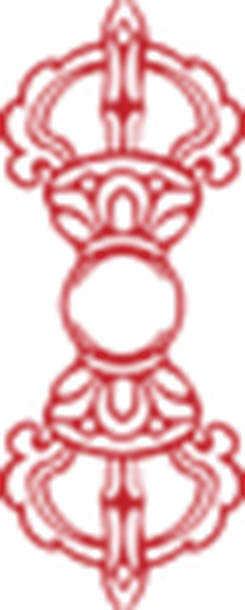
Dorje ( Tibetan for "Lord of Stones", i.e. diamond)
It is an expression of the indestructibility and translucent clarity of the clear non-dual realization that is the nature of the Buddhas. This non-dual Buddha consciousness is active and manifests as all-pervading enlightened compassion. Thus it produces manifold skillful means which, like the hardest of stones - the diamond - shatter all ignorance and imperfection.
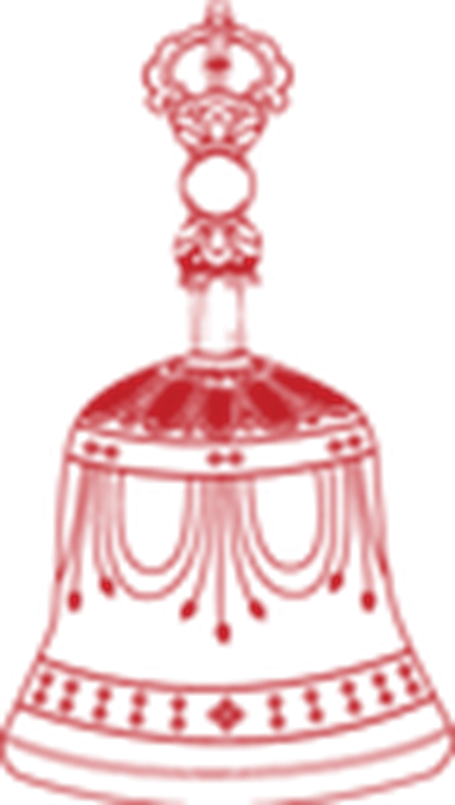
The bell (Tib. dilbu)
with its clear, distinct and at the same time fading sound, refers to the transience of phenomena and thus also to the transparency of the Void (Sanskrit: shunyata), which is their truth. In it all illusions of ignorance disappear. The realization of the impermanence of phenomena and of this their empty, transparent nature is the true enlightened insight, the realization of Wisdom (Sanskrit: prajna), which is the goal.
Double Dorje, (Tib. Dorje Gyatram)
If we know this meaning of vajra (dorje), then we can understand the symbol of the "crossed" or "double dorje". This expresses the penetration of this power - and thus its potential, its ability to "clarify and order all that is confused" - into all the cardinal directions of the cosmos.
Therefore, the double dorje also becomes the "orientation rosette", delineating the mandala's ground plan and the different world directions and sides contained in the mandala. The mandala itself is then an image of the world, seen and arranged by the enlightened mind.
The five colours
White, blue, yellow, red and green - the five brightest, most characteristic colours of the light spectrum. By composing and blending them, all the other colours are created, and thus the whole world appears in its visibility. These five colours draw attention first to the significance and importance of the number five itself. The distinction in "fiveness" (five moments, places, factors or components in the ordering of the world and its dynamics) appears in the very way the mind perceives and experiences the world (the four directions of the world and the center) and its own being. "Paternity" thus becomes the mind's way of glimpsing meaning, understanding, orienting itself in the space of the world, or ordering it meaningfully. At a higher level, it then emerges in the awareness of one's own potential, which the mind itself can develop through the experience of meditation and clarified consciousness. The mind can then distinguish in its personal karmic conditioning the five constituents of being which by their constellation constitute the personality, the five ways of developing disturbing emotions, and in contrast the five forms (forms or phases) of the illuminating, world-transcending wisdom of the Buddha.
At the most elemental level, the five colours are first the visible emanation of the five primordial elements: space, wind, fire, water and earth, by whose action the world and all its phenomena arise.
On the inner plane the colours and directions of space naturally correspond to the experience of the mind. Just as the mind in the process of meditation and awareness can discern in its karmic conditioning the five elements of being which by their constellation constitute the personality, and just as it can become aware of the five kinds of disturbing emotions which prevent it from attaining liberation, so in deep meditation the five forms (or phases) of the illuminating, world-transcending wisdom of the Buddha shine forth to meet it. The five colors thus become the colors of the five Buddha-forms - visualizations of the five aspects of transcendental Buddhahood, the five meditational, "dhyani" Buddhas and their Buddha-families into which all Buddha-aspects and forms are grouped.
With all these meanings, the colours correspond, receive, carry and pass on all this symbolism. The coherence of the light spectrum, the emergence of visible phenomena and the inner meanings of spiritual reality
The Five Buddha Families
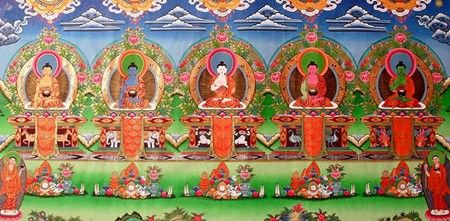
Ratnasambhava, Akshobhya, Vajrochana, Amitabha and Amoghasiddhi
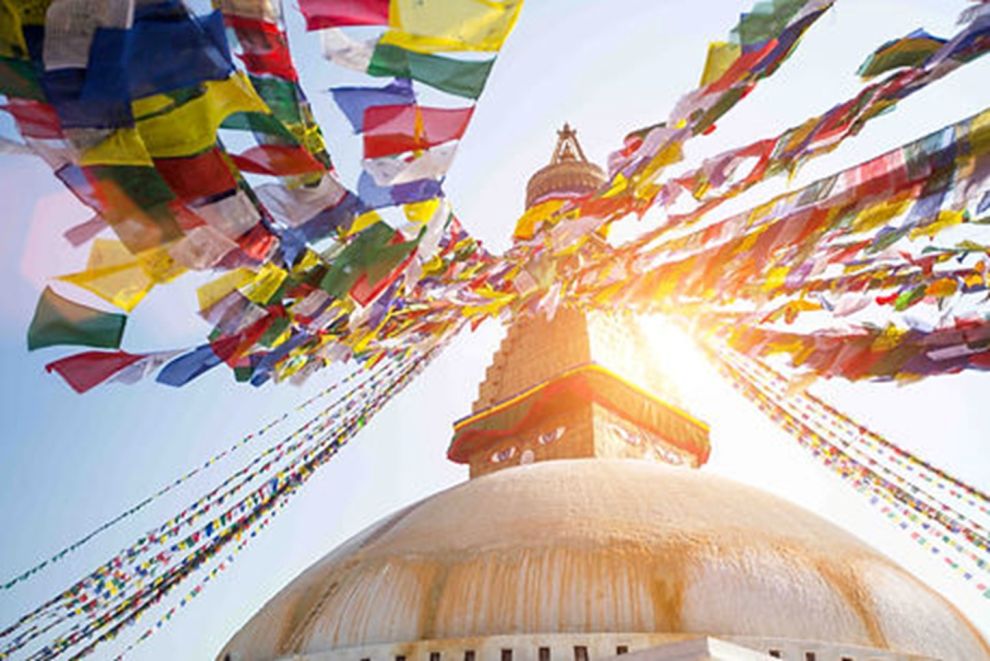
Lungta - Tibetan flags of mantras and wishes ( so-called "prayer flags").Traditional five-coloured cloth flags, printed with mantras and wishes.
They are placed in an open space to naturally connect with the energy of the wind. The wind, filled with a remembrance of the Dharma words printed on them and the good wishes associated with them, can then spread blessings into the space.
The flags are attached to ropes, which are therefore suitable to be tied in the open air. The five regularly recurring colours throughout the string evoke the five elements, the elements shaping the whole world of phenomena: in space (blue), which frames all the others, it is first the wind itself, the Tibetan lung (green) - the world breath, setting in motion life, which the flags make directly visible - followed by fire (red), water (white) and earth (yellow).