
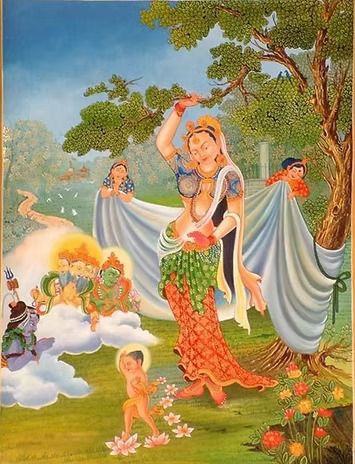
"After the child had first touched the ground, he showed his Buddha nature and the coming task of the Teacher by standing upright and making clear gestures - and nature joyfully responded. The deities of the elements washed them with a stream of lukewarm and cool celestial water, and the little prince then took seven steps in all directions. In these first footsteps, the lotuses then blossomed..."
Two methods are used to determine the anniversary date of the birth of the "historical Buddha" in various traditionally Buddhist countries and cultures. The first, practiced primarily in South and Southeast Asia, simply identifies the anniversary of the birth with the annual day of Awakening and passing into Parinirvana (death) and sets it on the full moon of the month of Vaisakha (vesak) in the Indian calendar, which then corresponds to the European full moon in May. This festival is then called in India and Nepal "Buddha jayanti ", "Buddha purnima" ("purnima", in Sanskrit "full moon"), in Sri Lanka and Southeast Asia Vesak etc.
In East Asian countries, originally oriented according to the ancient Chinese calendar, the anniversary of Buddha's birth is set on the 8th or 7th day of the fourth lunar month. In Tibetan, this month is called "Saga Dawa", and the seventh day is celebrated as Kutampa, the birthday of Buddha Shakyamuni (the festival of Awakening and going to Mahaparinirvana falls on the full moon, seven days later, on the 15th day of Saga Dawa).
The traditional narrative of the birth of Buddha Shakyamuni, the Great Teacher of this age, forms a coherent classical picture, composed of symbols and parables that together weave together this cosmologically unique and supremely solemn moment, while showing its meanings and context. The sacred situation is affirmed by the elements and celebrated by the whole of nature together with spiritual beings. The visual depiction of the birth of the coming Great Teacher of this age, Buddha Shakyamuni, is an iconographic theme shared by all strands of Buddhism and appears in temples of all its schools and lineages.
When karma ripened and time was fulfilled, the great Bodhisattva, who was to become the Great Dharma Teacher of the age to come in his next birth, handed over his diadem of the master teaching celestial beings in the happy heaven of Tushita to his successor in this task, the Bodhisattva Maitreya, to descend to his final birth himself.
To the chosen mother, Queen Maya (Mahāmāya), wife of King Shuddhodana of the Shākya family of Kapilavastu, the coming of the Buddha through her conception was announced by a dream vision of the coming white elephant. To give birth herself, she was to go to her parents' home, Devadasa, nine months later, to bring the child into the world there, according to custom, with the help of her mother.
On this journey by carriage, the queen was accompanied by her ladies-in-waiting and an armed guard for their protection. The hour, however, caught the queen on her way when the procession entered a grove of sisal trees near the village of Lumbini. Clinging to a branch of one of these trees, Mahamaya gave birth to Prince Siddhartha as easily and without much pain as if he had come out of her right side. At the birth, the most famous and revered spiritual beings of the time, the devas, appeared: the supreme Brahma himself and the Vedic god Indra/Shakra came to welcome and offer the first nurturing touches to the newborn child. After touching the earth for the first time, the child, by standing upright and making clear gestures, showed his Buddha nature and his upcoming task as Teacher - and nature joyfully responded. The deities of the elements washed him with a stream of lukewarm and cool celestial water, and the little prince then took seven steps in all directions. In these first footsteps, the lotuses then blossomed...