
According to Buddha Shakyamuni himself, as it is said in the White Lotus Sutra, Chenrezig was once an ordinary person like you or me. It is said that many aeons ago there was a king named Gyalpo Sergi Midjon who ruled a powerful Buddhist country. At that time, one of the king's minister's sons attained full enlightenment and was known as Tathagata Rinchen Nyingpo. This Buddha predicted that the king himself would become the Buddha Amitabha. He predicted that the king's elder son would become the bodhisattva of compassion, Chenrezig. The predictions came true, and the son who attained awakened compassion was reborn in the pure land of Potala, where he works ceaselessly to liberate beings from the entanglement of samsaric pain and suffering. Chenrezig, as a bodhisattva at the highest level, exists in dharmakāya, the all-pervading wisdom of space itself. To those who have awakened their realization, it manifests on the level of clarity.
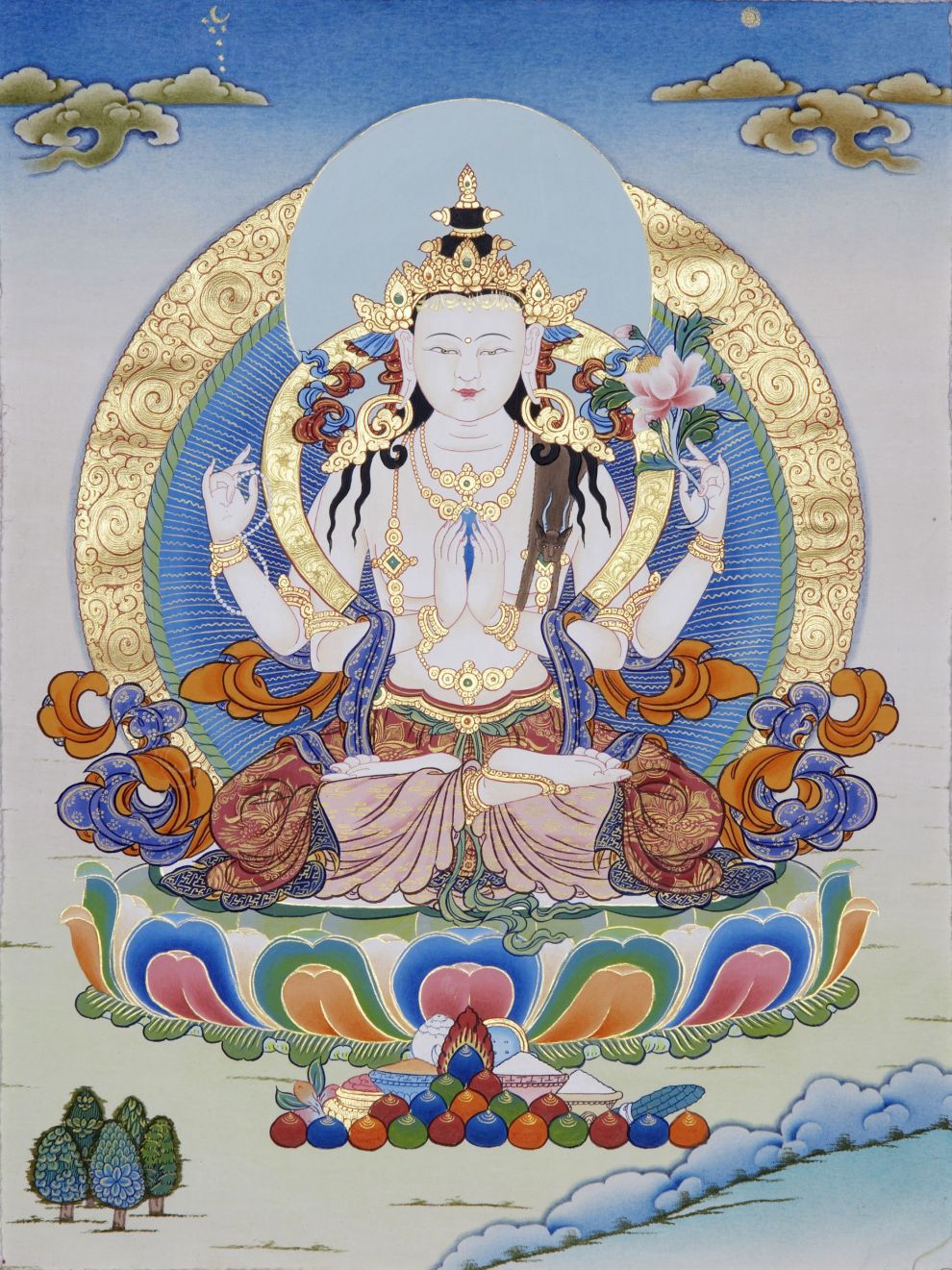
Another version of the origin of this yidam, outlined in the text known as Mani Khabum, describes Chenrezig's arrival in the relative world of phenomena. Amitabha Buddha saw from his pure land of Devachen the necessity of increasing his activity for the benefit of others. From his right eye he emitted a ray of white light and from his left a ray of green light. From one arose the manifestation of Chenrezig and from the other the Tara. Chenrezig was born in the kingdom of a ruler named Zangpocheog, Noble Kindness. He was discovered sitting on a lotus and lamenting the unbearable suffering of beings. The king accepted the little boy as his son and asked the Buddha Amitabha about the origin of this beautiful young man. "The child is the emanation of the activity of all Buddhas," replied Amitabha. "He is the one who realizes the benefit of all beings, the one who gladdens the hearts of all buddhas; his name is Chenrezig, the exalted ruler."
In the presence of Amitabha himself, Chenrezig took a vow to deliver all beings from suffering, regardless of the region of birth in which they are, and to bring them to awakening. He vowed that if he broke his vow, his body would shatter into a thousand pieces. In deep meditation, Chenrezig radiated rays of multicolored lights into the six regions of suffering and with these rays sent his own emanations there to benefit beings. Legend has it that the Bodhisattva Loving Eyes was able to empty the three lower realms of existence of their inhabitants three times. After meditation lasting many kalpas, he opened his eyes and saw that the lower realms were once again overflowing with suffering, and came to believe that this task was beyond even his abilities. In accordance with his promise, Chenrezig flew into a thousand pieces. At that moment, Amitabha began to work to rebuild the shattered bodhisattva in order to support his noble resolve. This time Amitābha equipped him with nine gentle faces and one angry one, crowned with his own head. He added a thousand hands with the eye of wisdom on each palm to completely empower the activity of this messenger of kindness. Along with all these additions, Amitabha imparted to the Loving Eyes the mantra OM MANI PEME HUNG as a means of transmitting its transforming power.
Loving Eyes can be viewed in three different ways. First, as a yidam, a manifestation of light and energy, inseparable from the fully awakened mind of our lama. In this form, Chenrezig appears as a meditation jidam, bestowing the fully realized wisdom of the Buddha directly upon the mind of the meditator. Secondly, the Loving Eyes can represent the embodiment of kindness and compassion itself. In this respect, all kindness, generosity, as well as the people who embody these qualities, can be seen symbolically or practically as the activity of the Loving Eyes.
In the third case, Chenrezig's meaning points to the absolute nature of the mind itself. Through insight, we can understand that all phenomena are the magical and dreamlike play of the uncreated mind, that the concepts of self and other are the disillusioned and fixated products of the relative mind and its unconscious and addictive clinging to the presence of the ego and the reality that exists outside. When we recognize that the idea of self and the idea of others are parts of one indivisible and enlightened whole, it becomes clear that, like Chenrezig, we cannot separate the good we wish for ourselves from that we wish for others. In this way, the mind is motivated by the wish to see all beings receive the supreme joy that we previously wished only for ourselves. From the level of understanding that our mind is an unborn, infinite, and conscious space, that the concept of others appears as a shining clarity within that space, the field of our compassion becomes infinite because from the perspective of the mind's highest viewpoint, we and all beings actually appear as buddhas.
Chenrezig or its manifestations have appeared in the world through emanations. Among them was recognized Songcan Gampo, the first Buddhist king of Tibet (617-692 CE), and also Padmasambhava (Guru Rinpoche, 8th century), who brought the dharma to this land. Others who have been recognized as Chenrezig include the Dalai Lama. He embodies the qualities of the calming four-armed aspect of Avalokiteshvara. The Gyalwa Karmapas are also considered to be emanations of the Loving Eyes through their seventeen incarnations. It is said that even before Dusum Khyenpa was recognized as the first Karmapa, this great achiever practiced on the aspect of the All-Powerful Ocean (Tib. Gyalwa Gyamtsho), the deeply mystical red form of Chenrezig in union with his partner. This Buddha aspect was one of the five tantras that Nāropa predicted would be brought from India to Tibet by a disciple of the Marpa lineage. These teachings were given by the achiever Khando Karpa to Iangpo Tiphupa, who passed them on to Milarepa's disciple Rachhungpa. Through this route, the Karmapa accepted and practiced this supreme mahaanuttantra and in effect became a Chanrazig himself.
It is said that Avalokitesvara appeared during the lifetime of Buddha Shakyamuni as one of his chief disciples. It plays an important role in many discourses including the Heart Sutra. In this teaching it is stated that at the request of the great Buddha, Avalokiteshvara imparted to his dear friend Sāriputra and many others the well-known teaching on absolute reality: "(...) form is emptiness. Emptiness is form. Emptiness is not different from form. And neither is form different from emptiness. Similarly, feelings, discriminations, skandhas and consciousness are empty. Sāriputra, all phenomena are only empty, they have no qualities. They have not been created and will never cease. They are not impure and are in no way separate from impurity." Avalokiteshvara continued as a speaker for the sangha and for those who sought only the benefit of others, "Bodhisattvas rely on and rest in the perfection of wisdom; there are no hindrances or fear in their minds. Through the complete transcendence of all depravity, they attain ultimate nirvana. Also, all the buddhas who perfectly rest in the three times have relied on the perfection of wisdom and have become apparent and complete buddhas in the state of unsurpassed, complete, and perfect enlightenment."
In another sutra, the prophecy of Buddha Shakyamuni is recorded that his beloved son of the heart, Avalokiteshvara, would in the future subdue the barbaric inhabitants of Tibet and lead them along the path to enlightenment. In general, we can say that the mandala or energy field of the Buddha or the Buddha wisdom aspect emanates from his absolute seed syllable and mantra. Therefore, the sound vibration embodying a particular buddha is inseparable from the quality of that aspect's energy and wisdom as well as its activity. Such is the case with Chenrezig's mantra OM MANI PEME HUNG , which is usually referred to as the "Six Syllables".
Sherab Gyaltsen Rinpoche is also considered an emanation of Chenrezig. You can read more about Chenrezig's meditation practice in his book The Buddha of Compassion. The meaning of the mantra OM MANI PEME HUNG can also be found in an excerpt from this book here
About the author
Brooke Webb lives at the Diamond Way Buddhist Center in San Francisco. She practices acupuncture and has been a Buddhist since 1991.
Translated from Buddhism Today No.7 by Veronika Cerna